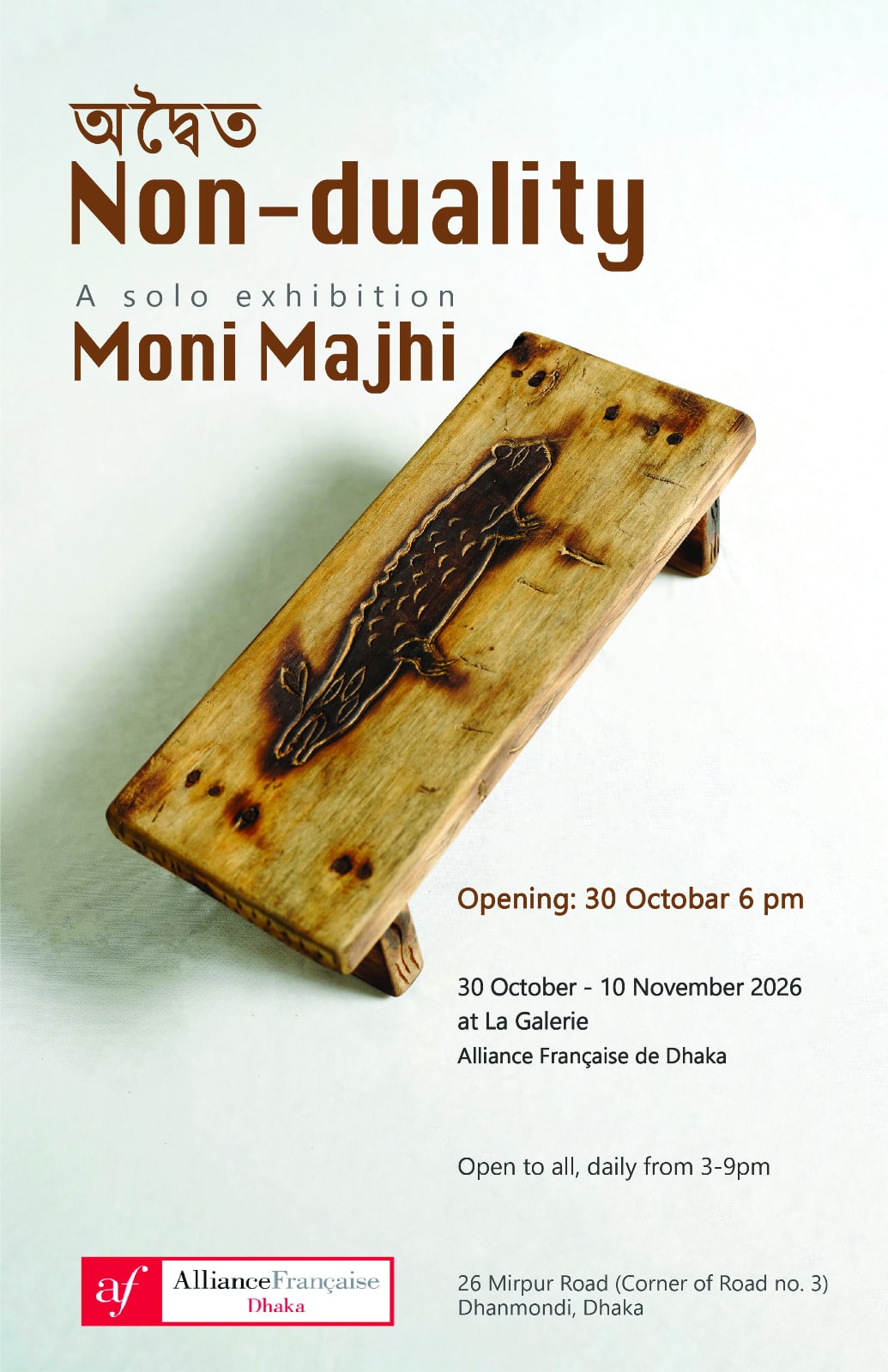
Rooted in the riverine landscapes of the Sundarbans, Non-duality by Moni Majhi explores the profound interdependence between humans, nature, and all living beings. Shaped by the rivers, forests, tides, saline waters, soil, animals, myths, and folk beliefs of this landscape, the exhibition reflects an understanding of existence grounded in shared memory, coexistence, and interconnectedness.
Here, Adwaita (Non-duality) is not a repetition of religious doctrine, but an expression of a lived cultural philosophy. It emerges from traditions in which distinctions between beliefs, identities, and forms of life become fluid. Bon Durga and Bonbibi are understood as the same Mother, while Paban Thakur and Paban Pir belong to a shared cultural imagination. These relationships reveal a worldview in which respect, hospitality, and coexistence are woven into everyday life.
The piri, a low wooden stool traditionally offered to a guest as a gesture of respect, becomes a significant symbol within this cultural landscape. Folk practices also recall moments when, amid violent storms and heavy rain, people offered sinni and payesh to Paban, the wind, in the hope of calming its force or allowing it to pass. Such gestures embody an intimate relationship with the natural world, one shaped by reverence, vulnerability, and the recognition that human life exists within forces beyond its control.
Yet these relationships are increasingly threatened by struggles for power, the control of natural resources, development, and the climate crisis. Rivers shift their courses, soil grows saline, animals lose their habitats, and communities experience the erosion of memory, language, and cultural identity.
In this ongoing displacement, we have all become “refugees of the green.” The loss of habitat extends beyond human communities to rivers, seeds, trees, and other living beings whose worlds are being altered or destroyed.
Through Non-duality, Moni Majhi revisits these fading relationships and asks how they might be remembered, restored, and reimagined. The exhibition invites us to reconsider our place in the natural world, not as spectators or owners, but as participants in a shared existence.
Ultimately, Adwaita offers a reflection on belonging, loss, and the possibility of reconnection. It reminds us that nature is not separate from us. We are shaped by the same earth, water, and breath. Our lives are inseparable from the lives around us, and the survival of one is bound to the survival of all.
Exhibition Details
Opening: 30 October 2026, 6:00 PM
Dates: 30 October – 10 November 2026
Venue:
Open to all